
In most warehouses, pallet damage is treated as a minor issue. A cracked board. Loose shrink wrap. A leaning stack of cartons. It looks manageable. It feels routine.
But damaged pallets in warehouses are rarely isolated problems. They are early indicators of wider operational risk, risk that affects safety, product integrity, compliance, and cost control.
Over time, unstable pallet loads and undetected pallet damage can quietly erode performance. And in high-throughput operations, small weaknesses scale fast.
Why damaged pallets in warehouses matter more than you think
A pallet is not just a transport base. It is a structural foundation. When that foundation weakens, several risks increase at once:
- Load instability
- Product damage
- Forklift handling difficulty
- Racking impact
- Falling goods
- Compliance exposure
In high-bay warehouses, the risk is amplified. Stock stored at height can hide pallet defects that are impossible to detect from ground level.
By the time instability becomes visible, damage has often already occurred.
The true cost of pallet damage risk
1. Product loss and write-offs
Unstable pallet loads are a leading cause of avoidable stock damage. When a load collapses or shifts, the damage rarely affects a single unit. It can impact an entire pallet position or neighbouring stock. Warehouse product damage prevention is not just about reducing waste. It protects margin, brand reputation, and service performance.
2. Investigation time and operational disruption
When product damage occurs, the direct cost is only part of the picture. The real cost often lies in investigation time. Managers, supervisors, and floor associates are pulled into reactive analysis. Productivity slows. Focus shifts from throughput to problem-solving.
Repeated incidents create a pattern of operational distraction.
The more frequently unstable pallet loads go undetected, the more investigation becomes embedded into daily routines.
3. Safety exposure and liability
Damaged pallets increase safety risk across the warehouse. Loose shrink wrap can catch on racking. Overhanging cartons can fall. Cracked pallet bases can collapse under weight.
These issues increase the likelihood of near misses, forklift incidents, falling stock or even workplace injury. From a pallet racking safety perspective, weakened loads also increase structural pressure on racking systems. In regulated environments, this may lead to audit findings, insurance scrutiny, compliance escalations and increased reporting requirements
Pallet damage risk is not only a cost issue. It is a governance issue.
Why manual warehouse inspections fall short
Most operations solely rely on manual visual inspections to identify damaged pallets in warehouses. Typically, this involves scheduled safety checks, supervisor walk-throughs and spot checks during shifts.
While important, these processes have limitations.
They are periodic, not continuous, dependent on human visibility, restricted by height, difficult in hard to reach locations and time-intensive.
In large distribution centres with thousands of pallet positions, consistent oversight becomes challenging. Issues can develop between inspection cycles. And in high-volume environments, turnover speed increases exposure. Manual processes alone struggle to scale.
The shift toward proactive warehouse product damage prevention
Modern warehouses are evolving. They are larger, faster, denser, more automated and more regulated. As complexity increases, reactive response becomes unsustainable.
Instead of waiting for damage to surface, some operations are exploring ways to embed detection into daily processes.
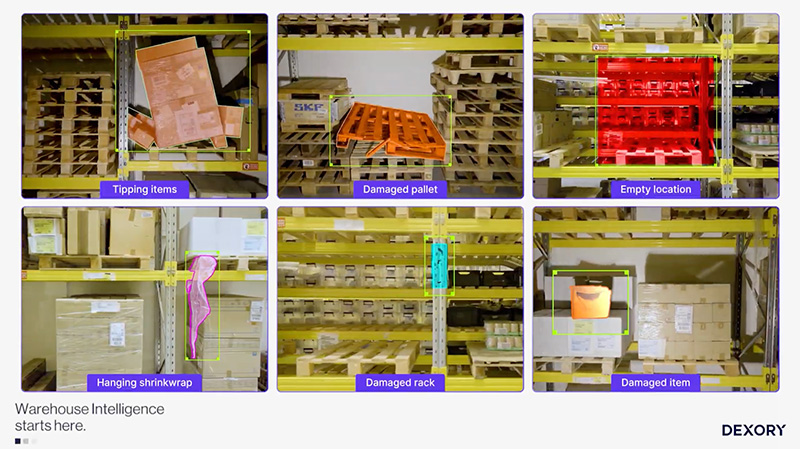
Emerging warehouse intelligence systems now combine inventory scanning with the ability to help to detect pallet defects, leaning loads, shrink wrap issues, structural irregularities
By identifying early indicators of pallet damage risk during routine scanning, operations can address instability before it escalates.
This approach helps to prevent product write-offs, investigation time, and safety exposure.
It shifts warehouse management from reactive correction to proactive control.
Key questions for warehouse leaders
To strengthen warehouse product damage prevention strategies, consider:
- How often are pallet conditions reviewed at height?
- Can unstable pallet loads be detected early?
- Are damaged pallets identified before they cause product loss?
- How much time is spent investigating preventable incidents?
- Is pallet racking safety monitored continuously or periodically?
These questions help reveal whether damage detection is systematic or incidental. In high-throughput environments, systematic visibility becomes essential.
The long-term impact of ignoring small instabilities
Damaged pallets in warehouses rarely cause immediate catastrophe. Instead, they create cumulative exposure. Small issues compound into repeated minor write-off, gradual safety deterioration, higher insurance risk, increased investigation workload and operational unpredictability.
Over months and years, these hidden costs can exceed the cost of prevention. Operational resilience is built on early detection, not late reaction.
Conclusion: Protecting stability at scale
Unstable pallet loads may appear minor on the surface. But in modern warehouses, small instabilities multiply quickly. As facilities grow taller, faster, and more complex, warehouse product damage prevention must evolve.
The goal is not simply to reduce visible incidents. It is to reduce hidden risk.
That requires better visibility, particularly at height and across dense storage areas.
Leading operations are beginning to combine inventory visibility with physical condition awareness, closing the gap between digital accuracy and structural integrity.
Because in today’s supply chain environment, knowing where stock is stored is only part of the equation.
Knowing that it is safe and stable is what protects performance.
Want to learn more about Dexory’s Storage Health feature?
Warehouse product damage prevention becomes far more effective when visibility is embedded into everyday operations.
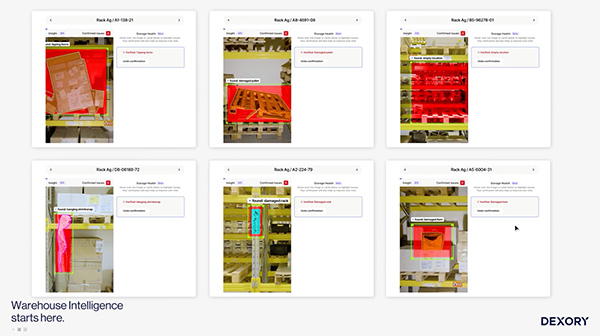
Dexory’s Storage Health capability is designed to help identify signs of pallet damage, unstable loads, shrink wrap issues, and structural irregularities during routine warehouse scanning. By combining inventory visibility with physical condition awareness, it helps operations surface early indicators of risk
If you’d like to explore how continuous detection can support pallet racking safety and reduce investigation time, you can see how Storage Health works.
SC
MR

More Inventory Management
- Innovators Netstock, Pickle Robot win NextGen Solution Provider awards
- From salon to dock door: Repurposing scheduling software for inbound flow
- Rebuilding a planning function around the physical world
- NextGen Supply Chain Conference unveils agenda focused on AI, execution and the future of leadership
- From fragmented negotiations to coordinated negotiation performance: an AI-enabled approach
- Coordinating AI-enabled supply chain operations
- More Inventory Management
Latest Podcast
 Explore
Topics
Procurement & Sourcing News
- Innovators Netstock, Pickle Robot win NextGen Solution Provider awards
- From salon to dock door: Repurposing scheduling software for inbound flow
- The biggest barrier to AI in supply chains isn’t technology
- Rebuilding a planning function around the physical world
- Why companies blame the wrong supplier … and miss the real failure
- NextGen Supply Chain Conference unveils agenda focused on AI, execution and the future of leadership
- More Procurement & Sourcing
Latest Procurement & Sourcing Resources
Subscribe

Supply Chain Management Review delivers the best industry content.

Editors’ Picks



